How a Virtual Assistant Can Save Your Business Time and Money
- Virtual Assistant
- Time Management
- Cost Savings
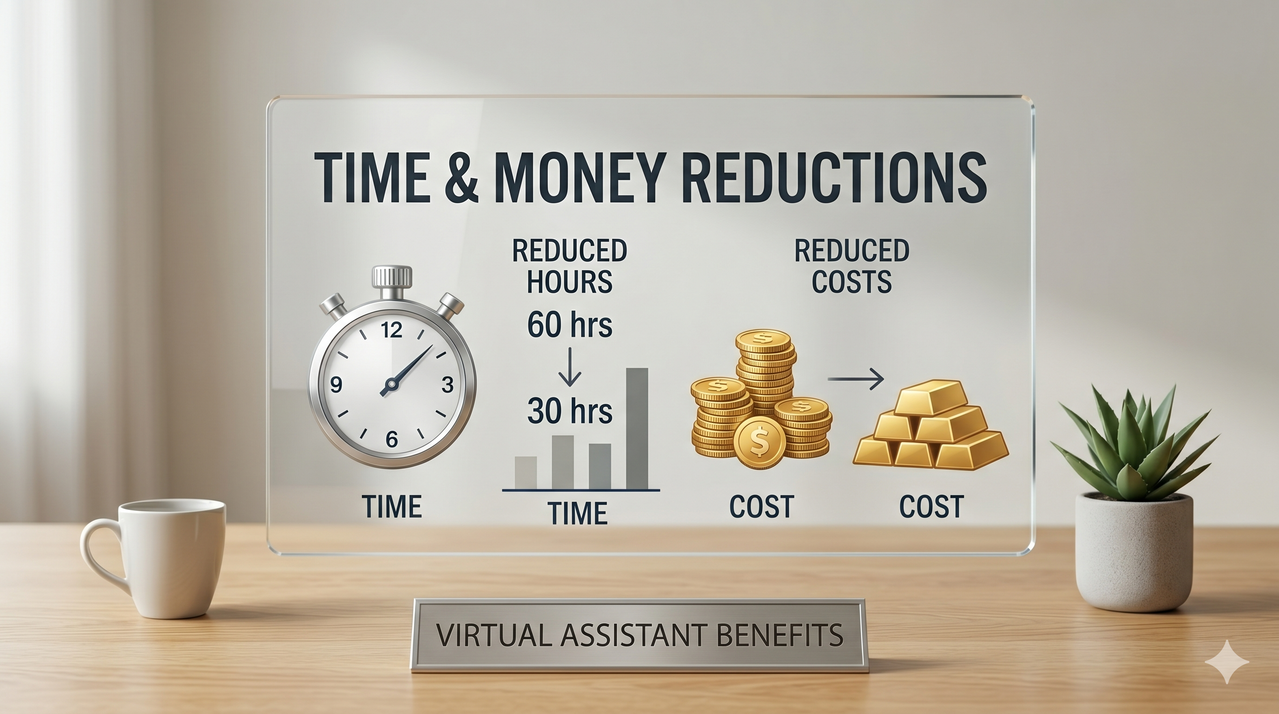
Discover how a virtual assistant can save your business time and money by delegating routine tasks, optimizing costs, and reducing stress.
Running a business often means juggling a multitude of tasks each day. From managing emails and scheduling meetings to handling marketing and bookkeeping, the list can feel endless. For many business owners, this constant hustle doesn't just lead to burnout—it actively steals time away from strategic growth.
If you are currently overwhelmed by daily operations, hiring a virtual assistant (VA) could be the ultimate solution to reclaim your time and drastically reduce your overhead costs.
## The Power of Delegation: Reclaiming Your Time
One of the most immediate benefits of hiring a virtual assistant is the significant chunk of time you get back.
- The Reality: On average, small business owners work 50–60 hours per week.
- The Drain: Roughly 40% of that time is consumed entirely by repetitive administrative tasks.
Imagine reclaiming 10 to 15 hours every single week simply by outsourcing tasks like email management, scheduling, and client follow-ups.
💡 Case Study: Email Management
Consider Sarah, a marketing consultant who used to spend two hours daily just wading through her inbox. By partnering with Covenant VA, Sarah delegated email triage, filtering, and basic responses. She instantly freed up 10 hours a week, allowing her to refocus on high-ticket client strategy sessions and business development.
## Cost Efficiency: More Than Just a Salary
Many business owners hesitate to hire because they look at the cost of a traditional employee. However, hiring in-house involves expenses that go way beyond a base salary—including benefits, taxes, office space, and equipment. In fact, a traditional employee typically costs 1.25 to 1.4 times their actual salary.
In contrast, virtual assistants offer a highly cost-effective alternative:
- Predictable Pricing: VAs typically cost between $15–$35 per hour, depending on their skillset.
- Zero Overhead: You don't pay for their laptop, health insurance, or coffee. You only pay for productive hours worked.
📊 Financial Snapshot: Scaling vs. Hiring Full-Time
| Expense Type | Full-Time In-House Employee | Covenant Virtual Assistant |
| Salary/Rate | Fixed monthly salary | $15–$35 / hour (Pay-as-you-go) |
| Taxes & Benefits | Yes (Adds 25-40% to base) | None |
| Equipment & Workspace | Yes (Desk, computer, software) | None (VAs provide their own) |
| Commitment | Long-term contract / Full-time | Flexible / Scalable hours |
💡 Case Study: Scheduling and Bookkeeping
Tom, a freelance graphic designer, realized that the overhead of a full-time administrative assistant was unsustainable for his boutique agency. By switching to a VA for just 15 hours a week to handle client scheduling and basic bookkeeping, Tom managed to cut his monthly overhead costs by over $1,000 compared to a traditional hire.
## Flexibility and Scalability
As your business evolves, your support system should too. One of the greatest advantages of a VA is the ability to scale up or down based on your current workload, without the messy logistics of hiring or layoffs.
- Phase 1: Most clients start small with 10–20 hours per week of foundational support.
- Phase 2: After seeing tangible ROI, they seamlessly scale up to 30+ hours or add specialized VAs to the mix.
💡 Case Study: Social Media Management
Laura, an e-commerce entrepreneur, initially hired a VA for 10 hours a week to manage her brand's social media channels. Within a month, she saw a 30% increase in engagement. Confident in the ROI, she increased her VA’s hours to take over customer service emails, further amplifying her online brand presence.
## Overcoming the "Delegation Hurdle"
Handing over the reins can be tough. Many business owners fail to see results initially, but this is usually due to unclear instructions rather than a lack of VA capability.
Keep in mind that the first two weeks are naturally an adjustment period. However, by establishing clear communication channels and setting expectations early, you can expect your business momentum to accelerate rapidly.
💡 Case Study: Client Follow-Ups
James, a busy real estate agent, initially struggled to hand off his client follow-ups. After taking the time to record a few quick training videos and refining his expectations, his VA took over seamlessly. The result? James noticed a 20% increase in client satisfaction and engagement, directly leading to more closed deals.
## Emotional Relief: Reducing the Mental Burden
Beyond the math and the hours, there is a human element to delegation. The emotional burden of trying to be a solo practitioner, accountant, marketer, and secretary all at once is a fast track to burnout.
By offloading routine tasks, you alleviate chronic stress. This mental freedom allows you to focus on what truly matters: visionary business growth and reclaiming a healthy, enjoyable work-life balance.
## What Success Looks Like in the Real World
Imagine you’re Alex, a software developer spending 60 grueling hours a week juggling complex coding, client meetings, and back-end admin work.
After partnering with a virtual assistant, you hand over 20 hours of operational tasks per week—including calendar management, inbox filtering, and client report preparation.
The result after just one month?
You have reclaimed valuable creative energy to focus purely on product development, leading to a 25% increase in project completion rates and a massive boost in client satisfaction.
## Frequently Asked Questions (FAQs)
How do I start delegating to a virtual assistant?
Start by tracking your time for a few days to identify repetitive, routine tasks that drain your energy. Document a few basic guidelines for those tasks, hand them off to your VA, and start with a modest bucket of hours that you can scale later.
What tasks can a virtual assistant handle?
Almost anything digital! Common tasks include email management, calendar scheduling, customer follow-ups, data entry, social media scheduling, and basic bookkeeping.
How do I ensure effective communication with my VA?
We recommend using central project management tools like Trello, Asana, or ClickUp, paired with a clear communication channel like Slack or WhatsApp, alongside brief, regular check-ins.
How quickly can I expect to see results?
While the first two weeks involve a natural learning curve, most business owners see a dramatic return on their time investment within the first 30 days.
How much does a virtual assistant typically cost?
Rates generally range from $15 to $35 per hour, shifting based on the technical expertise required and the complexity of the tasks.
## Conclusion
Hiring a virtual assistant isn’t just about offloading busywork; it is a strategic business move designed to optimize your costs and buy back your time. Start small, communicate clearly, and scale as your revenue grows.
At Covenant VA, we specialize in matching overwhelmed business owners with highly skilled virtual assistants who can seamlessly transform your day-to-day operations.
Ready to stop grinding and start growing? Contact Covenant VA today to find your perfect match.