How Successful Founders Use Virtual Assistants Daily
- VirtualAssistants
- FounderProductivity
- ScaleYourBusiness
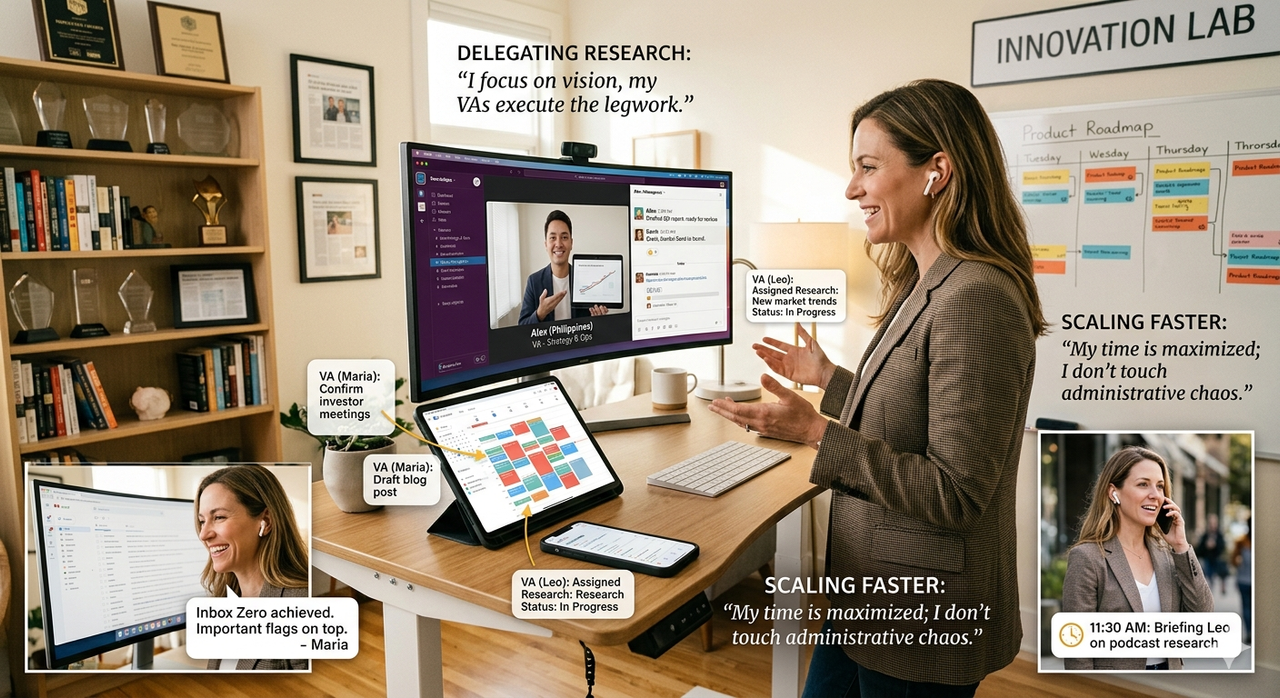
In the early stages of building a company, founders often wear every hat (e.g., operator, marketer, customer support, and strategist). But as businesses grow, the most effective founders recognize a critical shift: their time becomes the company’s most valuable resource. That’s where virtual assistants come in not as a luxury but as a strategic necessity.
Here’s how successful founders integrate virtual assistants (VAs) into their daily routines to scale faster, stay focused, and avoid burnout.
1. They Ruthlessly Offload Low-Value Tasks
Top founders are highly selective about how they spend their time. If a task doesn’t directly contribute to growth, strategy, or revenue, it’s a candidate for delegation. Virtual assistants commonly handle inbox and calendar management, data entry and CRM updates, travel bookings and scheduling, or basic research.
By removing these repetitive tasks, founders reclaim hours each day for high-impact work like decision-making and product development.
2. They Start the Day with a Pre-Organized Agenda
Instead of sorting through emails or figuring out priorities each morning, successful founders rely on their VAs to prepare a structured daily plan. A typical VA-supported morning might include a summarized inbox with only critical messages highlighted, a prioritized to-do list aligned with business goals, or re-briefs for meetings (key points, participants, objectives).
This allows founders to begin the day with clarity and momentum, rather than confusion.
3. They Use VAs as Communication Gatekeepers
As visibility grows, so does inbound communication. Without a filter, emails, meeting requests, and messages can quickly overwhelm a founder. Virtual assistants act as the first line of defense by filtering spam and low-priority messages, responding to routine inquiries, and lagging only high-importance conversations.
This ensures founders stay accessible (but not distracted).
4. They Delegate Research and Information Gathering
Whether it’s market trends, competitor analysis, or potential partnerships, founders constantly need information. But sometime, gathering it can be time-consuming. Virtual assistants streamline this by conducting preliminary research, compiling reports and summaries, or presenting key insights in digestible formats.
Instead of spending hours searching, founders can make decisions quickly based on curated data.
5. They Systematize and Document Everything
Successful founders don’t just delegate. They build systems. Virtual assistants often help create and maintain documentation that keeps the business running smoothly. This includes standard operating procedures (SOPs), workflow documentation, or internal knowledge bases.
Over time, this reduces dependency on the founder and makes scaling far easier.
6. They Extend Their Productivity Beyond Working Hours
Many founders work with VAs in different time zones, effectively creating a 24-hour workflow. For example: tasks assigned at the end of the day are completed overnight, reports and updates are ready by morning, or customer inquiries are handled even outside business hours.
This “always-on” productivity model accelerates progress without requiring longer working hours from the founder.
7. They Build Long-Term Partnerships, Not Just Hire Help
The most successful founders don’t treat VAs as temporary or transactional workers. Instead, they invest in long-term relationships. Over time, experienced VAs understand the founder’s preferences and decision-making style, anticipate needs before being asked, and take ownership of entire processes.
This transforms the VA from a task executor into a trusted operational partner.
8. They Continuously Optimize Delegation
Delegation isn’t a one-time event. It’s an evolving process. High-performing founders regularly review what they’re doing and ask:
“Is this something only I can do?”
If the answer is no, it gets delegated. As the business grows, VAs often take on increasingly complex responsibilities, such as project coordination, social media management, and/or customer success support.
Final Thoughts
Virtual assistants aren’t just about saving time. They’re about multiplying impact. By offloading operational tasks, founders can focus on what truly drives growth: vision, leadership, and innovation. The difference between overwhelmed founders and effective ones often comes down to this: the ability to let go of control in the right areas. And in today’s fast-moving business landscape, those who master delegation don’t just survive. They scale.