How Virtual Assistants Helped a Growing Retail Chain Save Money and Scale Faster
- virtual assistant
- retail business
- customer support
- retail operations
- remote staffing
- business growth
- administrative support
- after sales service
- retail management
- cost savings
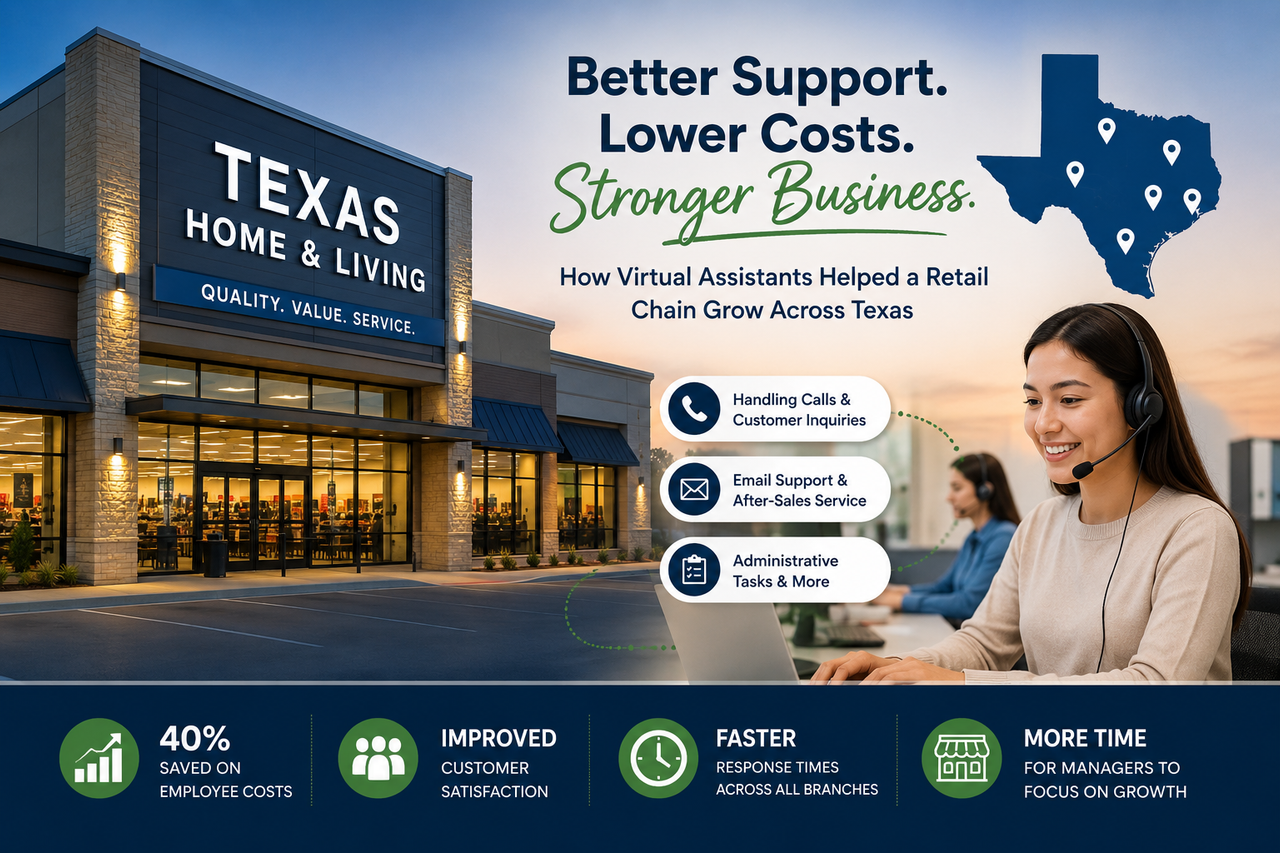
Discover how a growing retail chain used virtual assistants to handle customer calls, email support, after-sales service, and administrative tasks—improving customer experience while reducing labor costs and scaling faster.
Running a retail business with multiple branches is no small task. Between handling customer inquiries, answering phones, processing after-sales concerns, replying to emails, and managing daily administrative work, even the most successful retail stores can quickly become overwhelmed.
This was exactly the challenge faced by a growing retail chain in Texas.
With several branches spread across the state, the company had built a strong reputation for quality products and excellent customer service. But as their customer base expanded, so did the pressure on their in-store teams.
Phone lines were constantly busy. Customer emails piled up overnight. Store managers spent more time answering inquiries than focusing on sales and operations. Hiring more in-house employees seemed like the obvious solution — but the cost of salaries, benefits, office equipment, and additional workspace was becoming too expensive.
That’s when they decided to try a different approach: hiring virtual assistants.
The Problem: Growth Was Creating Operational Bottlenecks
The retail chain had seven active locations across Texas, each receiving hundreds of customer interactions daily.
Their biggest challenges included:
- Missed customer calls during busy store hours
- Delayed responses to customer emails
- Slow handling of returns and after-sales concerns
- Overworked store managers handling administrative tasks
- Rising labor costs from hiring additional in-store staff
Customers expected fast service, but the team simply didn’t have enough time in the day to manage everything efficiently.
The owners realized that if they wanted to continue growing, they needed support that was both scalable and cost-effective.
The Solution: Hiring Virtual Assistants for Customer Support and Administration
The company decided to hire a small team of virtual assistants dedicated to customer communication and administrative support.
The VAs were trained to handle:
- Incoming customer phone inquiries
- Product availability questions
- Store hour inquiries
- Order follow-ups
- After-sales customer support
- Returns and exchange coordination
- Email support
- Appointment scheduling
- Administrative data entry
- CRM and customer database updates
Instead of overwhelming store employees with nonstop customer communication, the virtual assistants became the first line of support.
Customers could now reach someone quickly without waiting on hold for long periods.
How the Virtual Assistants Improved Customer Experience
One of the biggest improvements came from faster response times.
The VAs answered customer calls throughout the day, responded to emails promptly, and ensured customer concerns were properly documented and escalated when necessary.
This created a smoother customer experience across all branches.
Customers no longer felt ignored or frustrated waiting for callbacks.
The retail chain also noticed that customers appreciated having a dedicated support team that could answer questions professionally and consistently.
Studies show that businesses using virtual assistants for customer support often improve operational efficiency while reducing support costs. Many companies report saving 30% to 50% compared to hiring additional in-house staff.
The Financial Impact: Significant Savings on Labor Costs
Before hiring virtual assistants, the retail chain considered adding several full-time employees across their branches.
However, the actual cost of in-house hires included:
- Salaries
- Benefits
- Payroll taxes
- Office equipment
- Additional workspace
- Training costs
By hiring remote virtual assistants instead, the company dramatically reduced overhead expenses.
Virtual assistants work remotely, which eliminates many traditional employment costs while still providing professional support services.
The company estimated that they saved nearly 40% annually in labor-related expenses after integrating virtual assistants into their operations.
Those savings were reinvested into:
- Marketing campaigns
- Inventory expansion
- Store improvements
- Customer loyalty programs
Increased Productivity for Store Managers
Another major benefit was giving store managers more time to focus on revenue-generating activities.
Instead of constantly answering phones or managing customer emails, managers could focus on:
- Improving in-store customer experience
- Training employees
- Increasing sales performance
- Managing inventory
- Expanding operations
Research consistently shows that delegating administrative work to virtual assistants improves productivity and allows leadership teams to focus on business growth.
The business owners quickly realized that virtual assistants weren’t just reducing workload — they were helping the entire company operate more efficiently.
Scalability Without the Stress
As the retail chain opened additional branches, adding support became much easier.
Instead of leasing more office space or hiring additional in-house administrative staff, they simply expanded their virtual assistant team.
This gave the company the flexibility to scale customer support based on business demand.
During holiday seasons and major sales events, the VAs handled increased call volume and customer inquiries without overwhelming the retail staff.
That flexibility became one of the company’s biggest competitive advantages.
Why More Retail Businesses Are Turning to Virtual Assistants
Retail businesses today operate in a highly competitive environment where customer experience matters more than ever.
Customers expect:
- Fast responses
- Friendly communication
- Efficient after-sales support
- Consistent service across locations
Virtual assistants help retail companies meet those expectations while controlling operational costs.
From customer support and phone handling to email management and administrative work, VAs provide retailers with reliable support that grows alongside the business.
Many retailers now use virtual assistants specifically to improve customer communication, reduce overhead costs, and create more efficient operations.
Final Thoughts
For this Texas-based retail chain, hiring virtual assistants became one of the smartest business decisions they made.
What started as a simple solution for answering phones evolved into a long-term strategy for scaling operations, improving customer service, and reducing labor expenses.
Their virtual assistants became an extension of the company — helping customers, supporting store operations, and allowing leadership to focus on growth.
In today’s retail environment, businesses that leverage virtual assistants gain more than just extra help. They gain flexibility, efficiency, and the ability to grow smarter while keeping costs under control.
For multi-location retail stores looking to improve customer service while reducing overhead, virtual assistants are no longer just an option — they’re becoming a competitive advantage.