Virtual Assistant vs. Employee: Which Saves More Money?
- virtual assistant
- virtual staffing
- employee vs virtual assistant
- remote staffing
- staffing costs
- reduce overhead
- business growth
- outsourcing
- small business
- administrative support
- workforce solutions
- Covenant VA
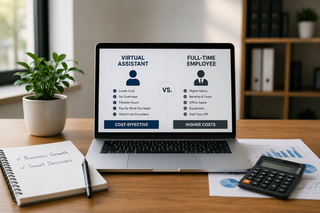
Should you hire a full-time employee or a virtual assistant? Compare the true costs, flexibility, and benefits of both staffing options to determine which can deliver the best value for your business.
When a business starts getting busier, one of the biggest questions owners face is:
Should I hire another full-time employee, or should I work with a virtual assistant?
There isn't one answer that works for every business. Full-time employees can be the right choice for roles that require a physical presence, specialized responsibilities, or long-term in-house collaboration.
However, for many administrative, customer service, and support tasks, a virtual assistant can provide the help a business needs while offering a more flexible and potentially more cost-effective staffing model.
The important thing is to look beyond the hourly wage.
The real cost of an employee includes much more than their paycheck.
The Cost of a Full-Time Employee Goes Beyond Salary
When calculating the cost of hiring an employee, many business owners focus on the advertised salary or hourly rate.
But an employee's total cost can include:
- Salary or hourly wages
- Payroll taxes
- Health and other employee benefits
- Workers' compensation
- Paid time off
- Retirement contributions
- Recruitment expenses
- Onboarding and training
- Office space
- Computer and equipment costs
- Software and technology
- Utilities and other workplace expenses
These costs can add up quickly.
For example, an employee earning a certain hourly wage may ultimately cost the business significantly more once benefits, payroll-related expenses, equipment, and other overhead are included.
That doesn't mean hiring employees is a bad decision. It simply means business owners should understand the true cost of adding another employee to the team.
What Does a Virtual Assistant Cost?
Virtual staffing typically works differently.
Instead of adding another traditional employee to the company's payroll, a business can work with a staffing provider that supplies remote professionals to handle specific responsibilities.
Depending on the role, experience, schedule, and services required, businesses may pay an hourly or monthly staffing rate.
The business can then allocate support to the tasks it actually needs help with rather than automatically committing to all of the expenses associated with a traditional full-time hire.
This can make remote staffing particularly attractive for small and growing businesses.
A Simple Cost Comparison
Consider a business that needs help with administrative work, customer support, scheduling, and email management.
A traditional employee may require expenses beyond their base compensation.
A virtual staffing solution may instead provide a remote professional who works on the required schedule and handles the assigned responsibilities without requiring the business to provide a traditional office setup.
The comparison should therefore look something like this:
| Cost FactorFull-Time EmployeeVirtual Staffing | ||
| Salary/Wages | ✓ | ✓ |
| Payroll-related expenses | ✓ | Depends on staffing arrangement |
| Employee benefits | Often ✓ | Typically not the same structure |
| Paid time off | Often ✓ | Depends on agreement |
| Office space | May be required | Typically not required |
| Office equipment | May be required | Typically reduced |
| Recruitment | ✓ | Staffing provider can assist |
| Training/onboarding | ✓ | Still required for business-specific processes |
| Flexible staffing | Limited | Often more flexible |
| Administrative workload | Higher | Potentially lower |
The exact savings will vary by business, location, role, schedule, and staffing arrangement.
That's why businesses should compare the total cost of staffing, rather than simply comparing hourly rates.
Where Virtual Assistants Can Provide the Most Value
Virtual assistants can be especially useful for responsibilities that don't require someone to physically be in the office.
These may include:
Administrative Support
A VA can help manage repetitive administrative work such as data entry, document organization, spreadsheet updates, and general office support.
Email Management
Instead of allowing an inbox to become a daily distraction, a VA can monitor messages, organize requests, respond to routine inquiries, and escalate important issues.
Customer Support
Remote staff can assist with customer inquiries through phone, email, or chat, helping businesses provide more consistent communication.
Appointment Scheduling
A VA can coordinate calendars, schedule appointments, send reminders, and help reduce missed opportunities.
CRM Management
Keeping customer records updated is essential, but it can also be time-consuming. A VA can help maintain CRM information and ensure follow-ups are properly documented.
Lead Generation and Follow-Up
Remote staff can research prospects, update lead lists, perform initial outreach, and follow up with potential customers according to the company's process.
Social Media Support
Businesses can also delegate content scheduling, basic engagement, research, and social media administration.
The Hidden Cost of Doing Everything Yourself
There is another staffing option that business owners often overlook:
Doing the work themselves.
At first, this may seem like the cheapest option.
After all, there is no additional paycheck.
But there is an opportunity cost.
If a business owner spends three hours every day answering emails, updating spreadsheets, scheduling appointments, and following up with leads, that's three hours they aren't spending on sales, business development, customer relationships, or strategic planning.
Your time has value.
Sometimes the most expensive employee isn't the person you're paying.
It's the business owner spending valuable time on tasks that could be delegated.
Virtual Assistants Can Help Businesses Scale
Another advantage of virtual staffing is flexibility.
A business may not immediately need a traditional full-time employee.
Perhaps the company only needs administrative support for a few hours each day. Or maybe workload increases during a particular season.
Remote staffing can allow businesses to build support around their actual workload.
As the business grows, the level of support can potentially grow with it.
This can be particularly useful for startups, small businesses, and companies that want to control overhead while expanding.
What About Quality?
Cost savings should never be the only consideration.
A low-cost staffing solution that produces poor-quality work isn't a good investment.
The goal should be to find the right balance between:
- Cost
- Experience
- Reliability
- Communication
- Quality
- Productivity
- Availability
A well-trained virtual assistant should be treated as an important part of the team.
Clear expectations, proper training, good communication, and access to the right tools are essential for success.
When Should You Hire an Employee Instead?
Virtual staffing isn't right for every position.
A traditional employee may make more sense when a role:
- Requires a physical presence
- Involves highly specialized in-person work
- Requires constant collaboration in a physical location
- Depends on equipment that cannot be accessed remotely
- Has responsibilities that are difficult to perform remotely
The goal isn't to replace every employee with a virtual assistant.
It's to determine which roles truly need a traditional employee and which responsibilities can be handled remotely.
Industry Examples
Insurance Agencies
Insurance brokers and agencies often spend significant time on policy renewals, certificates of insurance, client servicing, documentation, data entry, and follow-ups.
Many of these responsibilities can be supported remotely, allowing insurance professionals to spend more time selling policies and building client relationships.
Real Estate
Real estate professionals can delegate administrative tasks such as appointment scheduling, CRM updates, lead follow-up, listing support, and customer communication.
This gives agents more time to meet clients, show properties, negotiate deals, and generate new business.
Construction
Contractors and construction companies can use remote administrative support for scheduling, data entry, customer communication, document management, invoicing support, and other office responsibilities.
This allows owners and project managers to spend more time managing projects and growing the company.
The Bottom Line
So, which saves more money: a virtual assistant or an employee?
For many administrative and support roles, virtual staffing can offer significant savings because businesses may avoid or reduce many of the overhead expenses associated with traditional employment.
But the bigger question isn't simply:
"Which one costs less?"
It should be:
"Which staffing model gives my business the best value for the work that needs to be done?"
A full-time employee may be the right investment for some positions. A virtual assistant may be the better solution for others.
The smartest businesses evaluate the role, workload, required skills, and total cost before deciding.
How Covenant VA Can Help
At Covenant VA, we provide U.S.-managed virtual staffing solutions that help businesses delegate time-consuming responsibilities to trained remote professionals.
Our virtual assistants can support businesses with:
- Administrative support
- Phone handling
- Customer service
- Email management
- Appointment setting
- CRM management
- Lead generation
- Data entry
- Social media management
- Executive assistance
- Project coordination
- Other business support functions
Our goal is to help businesses reduce unnecessary overhead while giving owners and their teams more time to focus on revenue-generating activities.
Ready to Compare Your Staffing Options?
Before adding another full-time employee, take a closer look at the actual work you need completed.
Some responsibilities may require an in-house employee. Others may be handled effectively by a trained virtual professional.
The right combination can help your business control costs, improve productivity, and create a more flexible workforce.
Sometimes, growing your team doesn't mean adding another desk. It means adding the right support.